Physiological support
Maintain oxygenation, perfusion, nutrients, waste removal, temperature, pH, electrolytes, and stability.
BCSS is a conceptual engineering research framework exploring how the original biological brain-system could be supported by preserving the physiological and cognitive conditions required for long-term continuity.
BCSS asks what biological support would be required if the original living process is to remain active.
Most continuity discussions focus on copying minds, preserving memories, or recreating behavior. BCSS begins from a different constraint: if the original process matters, then preserving the original biological system may be the first milestone.
BCSS treats the body as a set of support services. The question is not whether the whole body must be preserved, but which functions the brain actually requires: oxygenation, circulation, waste removal, nutrition, temperature stability, regulation, and monitoring.
BCSS 2.0 separates public vision from private technical development. The public-facing site explains the direction. The technical library organizes the deeper research.
Maintain oxygenation, perfusion, nutrients, waste removal, temperature, pH, electrolytes, and stability.
Recognize that preserving living tissue is not enough. The target is the functioning person: memory, identity, awareness, and cognition.
Use the brain's existing vascular, CSF, monitoring, and future neural interfaces rather than pretending every neuron must be wired individually.
Move from requirements and simulations toward staged testing, safety analysis, and carefully defined experimental milestones.
The current private library is organized as a numbered technical report series. These reports define the research architecture behind BCSS 2.0.
Research Program Overview
Neuronal Requirements Framework
Existing Technology Mapping
Biological Knowledge Gaps
Functional Module Architecture
Functional Requirements Specification
Synthetic Perfusion Medium Architecture
Master Controller & Closed-Loop Control
Safety, Redundancy & Fault Tolerance
Experimental Validation Roadmap
Prototype Development Strategy
Cognitive Preservation Layer
Biological Interface Architecture
BCSS figures summarize the architecture, control systems, biological environment, technology mapping, validation pathway, cognitive preservation layer, and biological interfaces.
Functional Module Architecture
Master Controller & Closed-Loop Control
Safety & Redundancy Architecture
Brain Physiological Environment
Existing Technology Mapping
Experimental Validation Roadmap
Cognitive Preservation Layer
Biological Interface Architecture
The core BCSS question is simple: what is the minimum viable environment required to support the original biological brain?
This is called MVBE: the Minimum Viable Brain Environment. It defines the target before any architecture, simulator, or prototype pathway can be evaluated.
BCSS Architecture v2.0 reframes the body as a modular support system. The brain sits inside a controlled support environment while external modules provide the services normally supplied by the body.
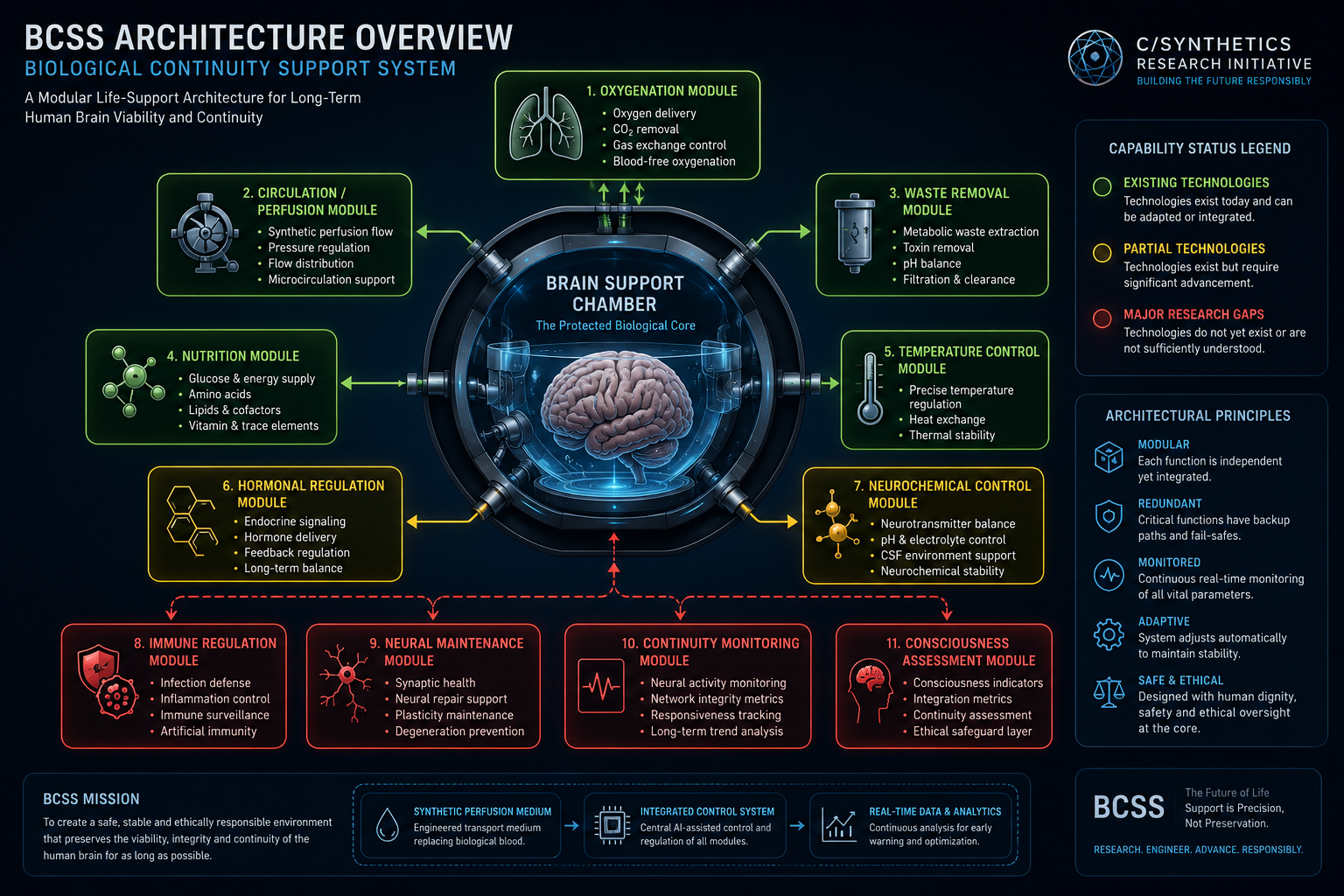
BCSS Architecture Overview — a visual concept showing the brain support chamber, support modules, and major capability gaps.
BCSS is organized into concepts, architecture documents, specifications, simulator models, and feasibility assessments.
Defines the minimum viable environment required for brain support.
Explores whether blood should be treated as a set of transport services rather than a biological substance.
A conceptual protected habitat where support services converge around the original biological brain.
Module definitions for oxygenation, circulation, waste removal, nutrition, regulation, chamber integration, and continuity monitoring.
A dependency and failure model exploring how module degradation affects overall brain-environment viability.
A reality-check document separating existing capabilities, partial capabilities, and major unresolved challenges.
BCSS is strongest where medicine already has transport and life-support technologies. The largest barriers remain long-term neuronal maintenance, cognitive preservation, biological interface stability, adaptive regulation, and continuity assessment.
Oxygenation, circulation, waste removal, nutritional support, and temperature regulation.
Hormonal regulation, environmental control, monitoring systems, and chamber integration.
Neurochemical regulation, immune regulation, long-term neural maintenance, cognitive preservation, biological interfaces, and continuity assessment.
BCSS is not a medical device. It is not a claim that brain preservation has been achieved. It is not a proposal for human experimentation.
BCSS is a research framework intended to identify what would be required before biological continuity preservation could ever become a serious engineering problem.
BCSS is still early. The current work is architecture, modeling, criticism, feasibility assessment, and research mapping.
Identify the minimum viable requirements for brain support with greater precision.
Model failure pathways and dependency interactions across the system.
Invite neuroscientists, critical-care researchers, bioengineers, ethicists, and skeptics to challenge the framework.
If you see a missing dependency, a false assumption, a technical path, or a reason BCSS fails, send it. Serious criticism is part of the work.